
Bluejay's Halfies System
Last update: August 2019
Full Bankroll
Even though the odds are against you in casino games, anything can happen in the short term. You're never gonna be a long-term winner, but in the short term you've got a fighting chance. It has to be that way, otherwise no one would gamble on games in which they're likely to lose. Your expectation is to lose, but with limited exposure (say, a weekend of play), you might come out ahead. Of course, if the odds are against you, then the longer you play, the more likely you are to lose. After thousands of rounds, you're really unlikely to be a winner.
So how can you use this knowledge to your advantage? Well, if you know that the longer you play, the more likely you are to lose, then that means that the shorter you play, the better your chances are of winning. And the shortest term you can have is just one play. And so statistically, that's your best bet: making just one even-money bet, putting all your money on the line at once. Crazy? Sure. Logical? Actually yes, according to the numbers. Fun? Probably not -- if you're going to Vegas you probably expect to spend some time gambling for fun rather than having everything be over after one bet, win or lose. But my variation on this idea can make it more interesting.
First, let's see how the basic system works without
modification. If you play this according to the numbers,
you place your entire bankroll (the amount you bring to
gamble) on a single low-edge, even-money bet, such as a baccarat (player)
hand, a pass line bet on craps. If you
win, walk away. If you lose, walk away. You've either doubled your
money or lost your whole bankroll. The pie chart shows your
nearly 50/50 chance of winning or losing, based on playing the Pass
Line in Craps.
Why you don't get exactly 50/50 odds
Your chances of winning or losing won't be exactly 50/50, because the casino doesn't give you an even chance. For example, your odds of winning a Pass Line bet in Craps is 49.3% (and your odds of losing are 50.7%). It's pretty close to a coin toss, but not quite.To win two of those bets back to back, your odds would be 49.3% x 49.3% = 24.3%, not the 25% that I depict in the charts below. In the examples on this page, we draw the pie charts as though there were no house edge. We do this in order to keep things simple, and because the effect of the edge in a low-edge game is not that significant if you're only going to make one or two bets. But realize that you don't actually get those 50/50 odds. It's close, but not quite.
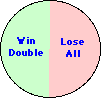 System A:
 1. Win. (You doubled your money, 49.3% chance*) 2. Lose. (You lost all your money, 50.7% chance*) See the sidebar to find out why the odds aren't exactly 50/50 odds.. |
The whole point of this system is to exploit short-term variance. After thousands of plays in a game with about a 1% house edge (like Baccarat) you could see how you'd probably be down close to 1%. But after just one play, you can't be down just 1%—you'll have either doubled your money or lost it all. You'll be ahead or behind by 100%. You've reduced your exposure to the house edge, although at great risk—as well as great potential reward. The point is: the fewer plays you make, the less significant the house edge is.
With that out of the way, let's discuss variations of the idea of making one big bet with your whole bankroll.
Betting what's left of your bankroll
Of course, playing just one hand isn't much fun for most people. So here's a way to make a big bet and still get in a decent amount of gambling time: Gamble normally on your vacation, making lots of small bets. At the end when you're about to go home, gamble what's left of your bankroll all at once, right before you leave. That way, you were able to play for hours with reasonable wagers, and you'll still have the opportunity for one last big-money bet when the odds are most favorable to you. It's still an all-or-nothing deal, but by doing it at the end of your trip you made sure you got to gamble normally, even if you lose your big bet.
And this is just the beginning. There are variations that can make an end-of-trip bet even more interesting...
Half Bankroll, Two Bets
I'm sure I'm not the first person to come up with this idea, but I haven't seen it anywhere else, so I'm calling it the "Half-Bankroll System". The idea is that instead of making one big final bet, you divide your remaining bankroll in two, and make two bets, each with half your bankroll. With the variations, this gives you three or more different ways to play (instead of the lone, single way to play if you bet everything), and this makes it a lot more interesting, as well as less risky. Here's how the basic system works: Remember that each time, you're betting the same amount of money—half of your original bankroll (the amount that you started the system with).
| System B:
1. Win, Win. (You doubled your money.) 2. Lose, Lose. (You lost all your money.) 3. Win, Lose. (You broke even.) 4. Lose, Win. (You broke even.) |
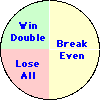 |
With this system, you're most likely to break even, which isn't even a possibility in System A. In exchange for that chance to break even, you reduce your chances of winning. Of course, you also reduce your chances of losing, so it evens out. Note that if you broke even, you're back where you started, so you might choose to start the sequence over again from the beginning.
Half Bankroll, Quit after Loss
But what if you decide that if you lose your first play, you're going to quit and not risk losing any more? In that case, the possibilities are:
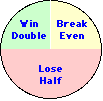 System
C: System
C: 1. Win, Win. (You doubled your money; 24.3% chance) 2. Win, Lose. (You broke even; 25% chance) 3. Lose. (You lost half your money; 50.7% chance) |
Now, at first glance it might seem that you have a 33% chance of each of these outcomes because there are three of them, but that's not the case. With your first bet, you've got about a 50% chance of either winning or losing. So imagine the top half of our circle being the Win scenario and the bottom half being the Lose scenario. If we lose in System C we give up, so the bottom half of the circle stays the same. But then the top half of the circle, the Win scenario, gets divided into two because w're gonna make another bet.
How does this compare with System B? Well, right off, you see that you increase your chances of losing, but if you do lose, you've lost only half your money instead of all of it. In fact, you can't lose all your money under this system. In exchange for the ability to not lose all your money, your chances of walking away as a loser (losing half) are increased, and your chances of breaking even are decreased.
Half Bankroll, Quit after Win
Here's the opposite of System C: Instead of quitting if you lose, you quit if you win your first play, and thereby lock in your 50% profit. Here's how that could work:
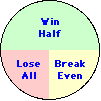 System
D: System
D: 1. Win. (You're ahead by half; 49.3% chance) 2. Lose, Win. (You broke even; 25% chance) 3. Lose, Lose. (You lost everything; 25.7% chance) |
Now, compare this to System C: Your chances of breaking even in each system are the same. In System D you have a better chance of winning, but if so you'll win only 50% instead of doubling your money. In System D you have less chance of losing, but if you do lose then you'll lose everything, instead of just part of it.
Now, what if you decided to quit if you win the first bet in order to lock in your winnings, and to quit if you lose your first bet in order to not risk any more of your bankroll? Then realize that this is really just another variation of System A, since you're making one bet no matter what; you're just betting a smaller amount.
Summary
Let's summarize the different systems:
One Bet, Whole Bankroll
Two Bets
Two Bets, quit if you lose the 1st one
Two Bets, Quit if you win the 1st one
So which one of these should you use? Hey, that's for you to decide -- this is gambling, remember? :) There's no way to predict whether you'll win or lose; my goal here has just been to show you your chances of winning or losing (or breaking even). The way you go about gambling is up to you.
Savvy readers may realize that you can expand this system further, by dividing your bankroll into 3 instead of 2, and making up to 3 bets. (Or dividing into quarters and making 4 bets.) That's certainly a possibility, but exploring the different possible outcomes is beyond the scope of this article. And remember, the more bets you make, the more you expose yourself to the house edge, which increases your chances of losing.
I hope this provides some food for thought. Good luck!
Related articles:
- Intro to Betting Systems
- Martingale betting system
- Martingale System Tester
- Betting System Tests
- $30,000 Betting System Challenge
- How to win $1 million