
Gambling 101
Last update: June 2021
The odds are against you
Casino games are set up so the player loses 1 - 12% of each bet on average, depending on the game. What this means is:
- You should expect to lose. After all, the odds are against you.
- The longer you play, the more likely you are to lose.
Let's see how this works, and we'll use coin flips because they're easy to understand. In our example game, you bet $1 on the flip of a coin, winning on heads and losing on tails. If it were a fair game, you'd win $1 when you win and lose your dollar when you lose. You can easily see that neither side has an advantage. If you played it forever you'd expect to neither win nor lose any money. Which is why you'd never see that kind of game in the casino. So let's casino-ize that game: Now when you win you get paid only 90¢, but when you lose you still give up your whole dollar. Ta-da, built-in advantage for the house. All casino games work on this same principle, paying you less than the true odds of winning. In other words, they shortchange you on the payout. Casino games are a lot more complex than the coin flip example so you can't easily see your disadvantage, but it's still there. For more, see my article on the house edge.
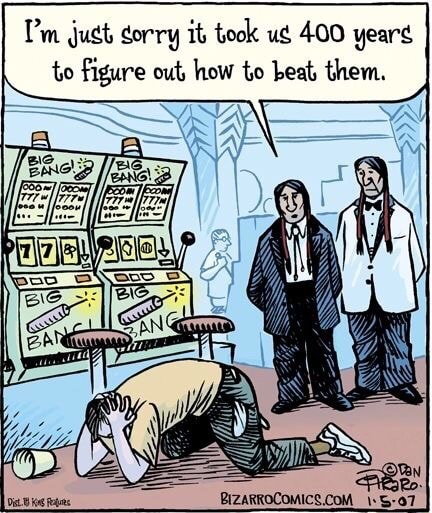
Licensed from Dan Piraro of Bizarro.
Is gambling stupid?
Since the odds are stacked against you, gambling might seem pretty dumb. And in fact, the fact that you're guaranteed to be a long-term loser is an excellent argument for not gambling. On the other hand, almost all entertainment costs money. If you get sufficient amusement for the money you parted with, then gambling is no different from other forms of entertainment. The average loss from betting $5 a round on a many popular table games with the proper strategy is only $8 an hour or less. That's certainly cheaper than any Vegas show, or even the movies. I have a hard time calling an $8/hr. loss stupid, for someone who can afford it. As long you don't expect to lose more than you'd spend on other entertainment, then gambling is simply entertainment as well.
The problem with gambling is that it's extremely easy to lose a lot of money, very quickly. That's the exact opposite of entertainment, because it's devastating. Of course, the best way to avoid that situation is to not gamble at all. If you go that route, you might be surprised you're in good company: one-fourth of Vegas visitors don't gamble a penny. (source)
If you're intent on gambling anyway, then this site will show you how to play smart and minimize your losses. Keep reading.
How to be a smart gambler
The cardinal rule of gambling is never bet more than you can comfortably afford to lose. If you simply follow that one rule religiously, you'll never get in trouble. Yeah, that should be obvious, but if it's so obvious then why do so many people ignore it? Promise yourself that you'll never bet more than you can afford. The best way to do that is to set loss limits and stick to them.
The other half of the equation is to play the right games, with the right strategy, for small stakes, and avoid the bad games. Slot machines will suck your money away hand over fist, while low-stakes blackjack with proper strategy will just sip your money away slowly.
So, putting all that together, here's your game plan:
- Set a daily loss limit and stick to it. If you lose your limit, stop playing.
- Quit while you're ahead. Do that by setting a win limit for your session, and stop if you hit it.
- Bank your wins. Set a win limit (say, $100, $300, whatever), and when you hit it, sock away half of it and don't touch it during your trip. Take it home with you.
- Figure how much you can expect to lose. See below for my Average Loss Calculator.
- Don't play slots. They suck your money away faster than the other games. If you must play, play no more than 25¢ total per spin (not a 25¢ machine where you play multiple lines and multiple credits per line).
- Play the games with the best odds (blackjack, craps, baccarat).
- Use the proper strategy for those games.
- Bet small and play slowly.
- Don't play on the strip. Downtown and locals casinos have better odds on both table games and slots, as well as lower minimum bets.
- Get a player's card and use it. When you use your card you'll earn comps (freebies like buffets, show tickets, rooms). See my article on comps for more.
- If you must play slots, play online. Land casinos typically take at least 8% of slot bets on average, while at online casinos it's often closer to 2-3%. For online, I like Bovada.
- If you play table games online, bet less. Online games are played much faster than in land casinos, so you'll lose a lot faster. Whatever you'd bet in a land casino, bet 1/5th of that online.
Se my article 12 Ways to Be a Smart Gambler for more details.
How much money should I gamble?
How much are you comfortable losing? Figure that out, and that's your budget for your trip. Don't plan on having anything left over, because it's quite common to blow it all. Base your budget on the idea that it's gonna be all gone, and pick a figure that you can comfortably afford to lose. Figure that number out before you leave on your trip. The worst time to decide on your budget is when you're in the casino in an excited state.
Once you've figured your trip budget, then divide it into daily budgets. If your trip budget is $300, then your loss limit per day for a three-day trip is $100 each day. If you lose your daily budget then stop playing that day, and do something else.
Once you know how much you're willing to risk, you can use
my separate article to figure how much to bet
per hand or per spin.
Strategy is important
Even you play the best games, without the right strategy you'll still lose more than you should. If you play craps but make the sucker bets, or make lots of bets at once, you might as well be playing a suck-you-dry slot machine. And with blackjack, you need to know whether to hit, stand, split, or double down on each hand, not to mention how to identify the best games. (For the strategy, you can see my blackjack strategy table, or buy a similar one at any Vegas gift shop for $2.)
The difference between playing smart and playing on a whim is staggering. With poor play you'll easily lose twice as much money, and 3x, 4x, and 5x isn't uncommon. Don't put a dime on the table until you know what you're doing. Start off with my crash course. If you want to practice, you can use Bovada's free online practice games. (You can close the box that asks you to register, and play without registering.)
Betting Systems
A betting system is a plan of how much to bet, based on whether previous rounds were wins or losses, or by making certain multiple bets (as in craps). People come up with them because they think the systems will make them winners, but systems don't work. The house edge is still there, no matter when, how, or how much you bet. If the house edge on a game is 4%, then the player is playing at a 4% disadvantage, whether s/he uses a system or not.
Betting systems never work in the long-term for one simple reason: the results of each round are random, and it's impossible to predict what's going to happen next. Just like it's impossible to predict the next result of a coin flip. Whatever's happened before has no bearing on future rounds. The mistaken belief that past results can predict future results is called the Gambler's Fallacy.
And stacking up a variety of bets in craps doesn't help, because the sum of a bunch of disadvantaged bets is still a player disadvantage.
Betting systems can increase your chances of winning in the short term, at a price. In exchange for a better shot of a short-term win, if you do lose, you'll lose big. For example, the Martingale Betting System has you double your bet after a loss. Say you bet $5 and lose. Next time you bet $10. If you lose you bet $20. If you lose you bet $40. At the end of the sequence when you finally win, you'll show a $5 profit. The main problem with this system is that if you lose a bunch of bets in a row you won't be able to afford to make the next bet. The other problem is that even if you could, the casino will limit how much you can wager.
A less dangerous system is to increase your bet by 50% every time you win. Say you bet $8. If you win then you'll increase your bet by half that ($4), so next time you'll bet $12. If you win that then you'll add $6, so you'll bet $18. If you win that then you add $9 so you're betting $27. Whenever you lose you start over with $8. This is safer than the Martingale because you bet more when you're winning, not when you're losing.
Another system is to bet half,
one-third, or one-fourth of your remaining chips on each hand.
That gives you a much greater chance of reaching a large goal (such
as to double the amount you started with) vs. flat-betting
(which means to bet the same amount on each round).
Betting systems can be fun, but they never reduce the house
edge. For more, see my separate
article on betting systems.
Gambler's Fallacy
If you're playing roulette and red has just come up ten times in a row, should you bet on red or black for the next spin? The answer is that it doesn't matter. Each result is equally likely. Past results do not influence future results. Many a gambler's downfall has been the mistaken belief that you can discern any kind of pattern in the results. It simply doesn't work that way. If it did, the casinos would not be standing. In reality, the casinos are happy to encourage people's delusions by providing pads of paper for them to keep track of previous spins, and they even have a marquee at the roulette table which shows the results of the last several spins. The casinos have no fear in providing this because they know there's absolutely no benefit to you in having that information. This is not a gray area, and it's not something that the experts disagree on: Every single mathematician on the planet will tell you the exact same thing, that each spin is absolutely random. For more, see my separate article on the gambler's fallacy.
What is the gambling age in Las Vegas?
You have to be at least 21 to gamble in Las Vegas, or even be in the gaming area. Someone under 21 isn't allowed to even stand or sit and watch someone else gamble. The hotels are set up so you have to walk through the casino to get to the elevators, so the idea is that if you're under 21, you have to keep moving.
Why do people gamble?
"Why people gamble" and "Gambling Addiction" are now on a separate page.
What's the difference between gambling and investing?
There's a fine line between gambling and investing. Both involve putting your capital at risk for the chance of getting more capital. The difference is that with investing (like with stocks), there's a positive expected value, while with casino gambling, your expected value is negative.
We call a positive expected value a "positive expectation", but it's a misnomer: we don't necessarily expect to wind up with a profit, we're just referring to the mathematical average. That means that having a "positive expectation" isn't the same thing as "likely to win". There are situations in which you'll probably lose, that are still a positive expectation. For example, an investment with only a 20% chance of turning a profit will probably result in a loss, but if the profit is five times your investment, your expectation is still positive:
| Invest $1000 with 20% chance of 5x profit | ||
| Probability | Return | Product |
| 20% | $5000 | $1000 |
| 80% | -$1000 | -$800 |
| Expected Value | $200 | |
So, the difference between gambling and investing is not
that with investing you'll probably win, because
sometimes, an investment will probably lose, but you still had a
positive expectation, which is what separates investing from
gambling.
When playing a casino game with a positive expectation (like counting cards in blackjack), I consider that investing, and not gambling.
Help me improve this article by letting me know what else I should include here.