
Coin-Pusher Games (like Flip-It)
Original: 2002 • Updated: August, 2018
"Just
wanted to thank you for writing the Flip-it analysis.
(I teach game design at MIT and handed it out in class.)" —
Jon
Introduction
This game goes by various names, but the concept is the same: A machine has two trays completely filled with coins. The upper tray slides back and forth and the bottom tray is fixed. You insert a coin, which drops onto one of the trays, and if you're lucky it'll get pushed into the stack of coins, causing one or more to spill over the edge and be returned to you.
The game takes quarters, dollars, or tokens, depending on the flavor of the machine. Video arcades sometimes pay out in tickets rather than actual coins.
In some flavors of the game the coins simply drop onto the tray. In the ones I used to see in Vegas, the coins were flipped up onto the tray by a spinner. That version of the game was called, appropriately enough, "Flip-It". Sadly, I haven't seen the game in Vegas in many years.
How the operator gets its profit
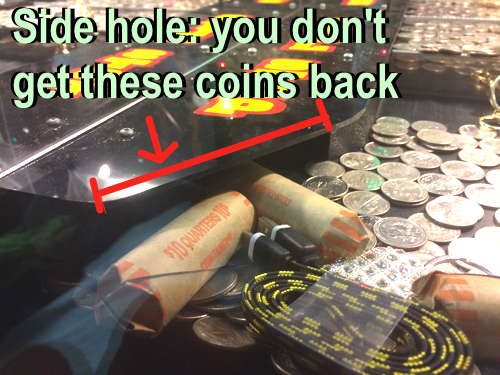
The operator makes its money from the coins that spill over on the extreme left or right edges, which get sucked into the machine instead of being returned to the player. This fact is not obvious, because the holes on the edges are hidden behind or underneath signage. Without knowing this, I've heard people opine that they figure the operator opens the machine at night and scoops some of the coins off the trays. That's not how it works. The profit comes from the (hidden) holes on the edges.
Although it's obvious how the operator profits once you find the edge holes, I did confirm anyway with staff at the Four Queens casino that they don't open up the machine at night to scoop out the coins.
Equilibrium
If you play the game long enough—and it doesn't take long—you'll notice that the machine always returns to an equilibrium. That is, the coins don't stack ever higher and higher. The average number of coins in the machine is pretty constant. The machine can get temporarily overloaded with "extra" coins, and then after a big payout it might have a deficit of coins, but with more play pretty soon it'll be returning to its happy balance.
Each machine has its own personality, and has a different average coin depth. That might be two coins deep on one machine and five coins on another.
It doesn't take long to see this effect. My experience is that on most machines you could observe it with fewer than 80 plays (e.g., $20 worth of 25¢ coins).
Basic Strategy
The machines let you choose whether you want your coin to drop in the left, middle, or right of the machine. Since you don't get coins that spill into the holes on the edges, the first part of basic strategy is to simply play the middle, minimizing the number of coins that go to the edges.
If your machine allows you to choose where your coin drops, then the second part of basic strategy is to time the drop so that your coin falls onto a naked space on the tray, behind all the other coins, so your coin pushes into the mass of coins. If your coin falls onto the top of the stack, it won't help push the coins towards the edge. The Flip-It games don't give you much of a choice as to where your coin drops. However, as we'll see later, these games are better for coin-counting advantage play.
The House Edge
Different machines carry different house edges, and seem to be in the range of 10-33%. Some games don't let you precisely control where the coins land. Games that send your coins to the edges sometimes will have a higher house edge than those which don't. Also, some games are just engineered so that more coins get pushed into the side holes than other games. Finally, trickery could increase the house edge even more...
Some operators put big prizes on top of the coins, like entire rolls of coins, which are always right near the edge, enticing you to play because they seem easy to win. The truth is that those prizes are unwinnable. The edge of the tray is hard to see because it's covered by coins, but if you look carefully you can see that it's slightly angled up. When the rolls of quarters get pushed up towards the edge, they'll simply roll back down the hill about an inch, farther away from the edge. In my mind, the presence of the coin rolls is fraudulently, criminally deceptive.
It might be worse than that the coin rolls are unwinnable. I suspect that the weight of the coin rolls causes more of the coins to spill over to the sides. Last night at a movie theater I played $20 and got back $13.50. The machine seemed to be in equilibrium, so that would make the house edge a whopping 32.5%.
I estimated the house edge on the dollar machine at the Four Queens to be about 11.1%. This was based on 405 coins in, 360 coins out, taking about an hour of play, and using Basic Strategy. On any other casino game, 405 rounds would be pitifully small and not at all statistically significant, but quarter pushers are different. A few hundred rounds easily cycles most of the coins in the machine, and it's very clear from playing even 15 minutes that the machine seeks its own level.
On Flip-It games, I found that quarters tended to flip to the sides more often than dollars because they're lighter and their trajectory is all over the map. I made a rough estimate that you could easily lose almost as much on quarters as on dollars, just because of all the extra quarters that go to the sides.
The Wizard told me that Stanford Wong calculated the house edge on the game to be about 10%, since the holes on the edges comprise about 10% of the total spill area width. That's a reasonable hypothesis, and indeed, in my testing I got 11.1% on a particular game which was pretty close, but another game I tested suggested the edge is a lot closer to 32.5%, possibly because the rolls of quarters could be encouraging coins to go into the side holes.
Volatility
Machines that gravitate towards shallow stacks have low volatility. You will hit frequently, but get just a few coins when you do. Machines that stack high will have greater volatility: You won't get payouts as frequently, but when you do, they'll be larger. The long run expected return is the same. The machine with the least volatility that I found was the dollar machine at Four Queens, which preferred to be about only two coins deep. The four-deep dollar machine at Stratosphere was much more volatile.
Baskets
Some versions of the Flip It game feature small baskets at the very top of the game, and if your coin flips all the way up there and into a basket, you win the number of coins listed on the basket (usually 10, 20, 50, or 100 coins). On some of the dollar machines, the 50-point baskets move continuously back and forth, left to right, for added excitement. If you hit one of these baskets, there's a bonus round where slot machine reels on the very top of the game spin, and various combinations pay various numbers of coins, with the top jackpot being $2500 or $9999. This jackpot is often listed in an LED marquee to make it look like it's a progressive jackpot, but it's really just a fixed jackpot being advertised with a marquee.
The baskets are nearly worthless. In thousands of Flip-It hands, I hit a basket maybe three times, each time the lowest-payout basket. As further proof, in the six weeks I was in Vegas, nobody hit a 50-point basket at the Four Queens dollar machine to get a reel spin. I know this because for the entire six weeks, the reels were stuck on the exact same combination. (And that was a losing combination to boot, that paid out zero coins for its bonus round.) The machines entice you to play the sides by putting the higher-point baskets on the sides. Don't fall for it. You won't hit the baskets, and your coins going to the sides of the machine won't get returned to you when they spill. Note that although I believe baskets to be nearly worthless, you're more likely to hit them on quarter machines than on dollar machines, because the quarters are lighter and flip up higher.
Coin Counting
Blackjack players can move beyond their basic strategy and count cards, giving them an advantage over the house. Flip-It players can likewise move beyond their basic strategy and count coins, so the odds are in their favor. The concept is simple: Play only when the machine is primed (holding more coins than average), so that coins are more likely to spill than stack. I believe this works only with the Flip-It games where you don't have much of a choice as to where your coin drops. On the games where you can choose to drop your coin onto a naked area of the tray, presumably most players will do so, so the coins won't stack very high. But in Flip-It games where your coin is flipped by spinners onto the trays, many of those coins are going to stack on top of other coins. It's the imbalance of high stacks which you'll be hunting.
I tested my theory by playing a trial of 558 coins over several days, playing only when I thought the machine was primed, and I wound up ahead 9 coins. This is a 1.6% advantage, which is more than you can get from counting cards at blackjack. (Blackjack is still more profitable, obviously, because you can bet more than a dollar at a time, and because profitable decks occur more frequently than profitable Flip-It shelves.) At one point in a separate trial, my advantage was 83% after playing only 24 coins.
Had I played more conservatively (playing only when the machine looked extra good), I'm confident that I could have achieved greater than a 101.6% return. But the return is not the ultimate indicator of how much money you make. What you ultimately walk away with is a function of your advantage multiplied by your action (how much money you put into the machine). Playing 500 coins conservatively with a 4% advantage yields the same profit as playing 1000 coins more aggressively with only a 2% advantage ($20, either way).
To count a machine accurately, you must first know how many coins deep that machine gravitates towards, which I'll refer to as the machine's "level". You could find this out by playing the machine for 15-30 minutes, or you could back-count the machine by simply watching someone else play. Once you know the machine's level, you can use a simple +/- count. Count only coins in the middle, not on the sides:
|
|
Every space and level where the stack is less than the level. For example, if this is a 3-deep machine, and there's a spot that's only 2 levels deep, there's one coin missing, so that's -1. If there's a spot that's only one level deep, then that's -2. Count every deficient spot this way. |
|
|
Every half-coin space and level where there's about a half-coin hole. The coins are not pressed together snugly, and you can see straight through to the shelf. When this happens and gap is about the size of half a coin in square inches, count -1 for each level. Let's say you have a 3-level machine with four half-coin gaps. You have 4 x -3 = -12. |
|
|
Every space and level where the stack is greater than the level. For example, if this is a three-deep machine, then count every coin on the 4th level as +1. |
|
|
Every coin that is teetering over the ledge by at least 1/3 coin. |
Add these all up and you have a rough idea of your advantage, or lack thereof. When you have a positive count, play the machine. If the machine is negative, don't play. If the machine is positive, and you play, and you win, count the machine again. If it's still positive, you can continue playing. Unlike blackjack, the pit bosses don't care if you back-count and Wong in when the count gets high, but you can't Wong in whenever you like, since only one person can play the machine at a time. You'll just have to hope that the person playing the machine before you leaves when you want them to.
I had an interesting experience at the Four Queens. I had been playing the machine for a while, and had relinquished it to a young woman who was watching me and was eager to play. I waited for her to finish, and then she turned the machine over to me (in about the same condition as I'd left it). She continued to watch me although she was ostensibly done playing. Soon I had a major hit for a bunch of coins, which instantly made the machine seriously negative. But as she jealously watched me get that big hit, she asked anxiously, "Can I play now?" I was only too happy to turn the negative machine back over to her at her request, so she could prime it for me again. Some might think I was taking advantage of her, but remember, she asked me to let her play.
The summary, though, is that although you can play Flip-It at an advantage, you can't make a living at it, unless you can live on a few dollars a day.
Casino Player
In the Dec. 2001 issue of Casino Player, the executive editor ran an article about how she lost $240 playing quarter Flip-It. It was hard for me to believe that someone could be so bad at Flip-It as to lose $240 playing for quarters. That's a loss of 960 coins! You'd have to play at least two hours straight and lose every coin to lose that much money! I suspect that the editor made up the numbers for her story, and/or fudged other details.
Further, I was challenged by the editor's assertion that "You simply can't win on this machine." I had always suspected that with proper play, Flip-It could actually be played at an advantage—in other words, profitably. That's why I set out to prove that I could win at Flip It. And I did.
[Update: Casino Player invited me to write a cover story for them in 2005, which I happily did. It was not about Flip It.]
Miscellaneous
Unfortunately, Flip It doesn't accept slot club cards. It should, considering that the house edge (≥10%) is at least as high as the edge on a typical slot machine.
Most Flip It machines have a sticker that says "Game is over 35 seconds after last coin is played. Coins spilled after this time will not be returned to the player." So if a batch of coins is teetering on the brink and about to spill, and you're waiting and watching while it takes a while for them to actually drop, you might not get them. But don't worry, 35 seconds is longer than it seems. I timed it and found that it took 20 strokes of a pusher arm to equal 35 seconds, so while waiting for coins to fall, I simply made certain that I didn't go longer than 15 strokes before I played my next coin.
I now know more about Flip-It than any person ever should. I'm not sure which was the bigger waste of my limited time on this planet: Trying to beat an insignificant casino game for an insignificant amount of money, or writing a lengthy article about it. Either way, this probably explains why I don't get many dates. [Update, nine years later: I'm married now.]
See also how to play: